Seed characteristics
Seed quality is determined by a number of genetic and physiological characteristics. The genetic component involves differences between two or more genetic lines, while differences between seed lots of a single genetic line comprise the physiological component. The genetic factors that can influence quality include:

The physical or environmental characteristics include:
- Injury during planting and establishment
- Growing conditions during seed development
- Nutrition of the mother plant
- Physical damage during production or storage by either machine or pest
- Moisture and temperature during storage
- Age or maturity of seed

Deterioration in seed quality may begin at any point in the plant’s development stage from fertilization onward. Seed quality depends upon the physical conditions that the mother plant is exposed during its growth stages, as well as during harvesting, processing, storage, and planting.
Temperature, nutrients, and other environmental factors also affect seed development and influence seed quality.
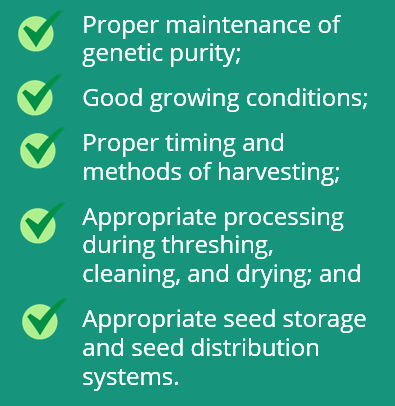
High-quality seed is the result of good production practices, which include:
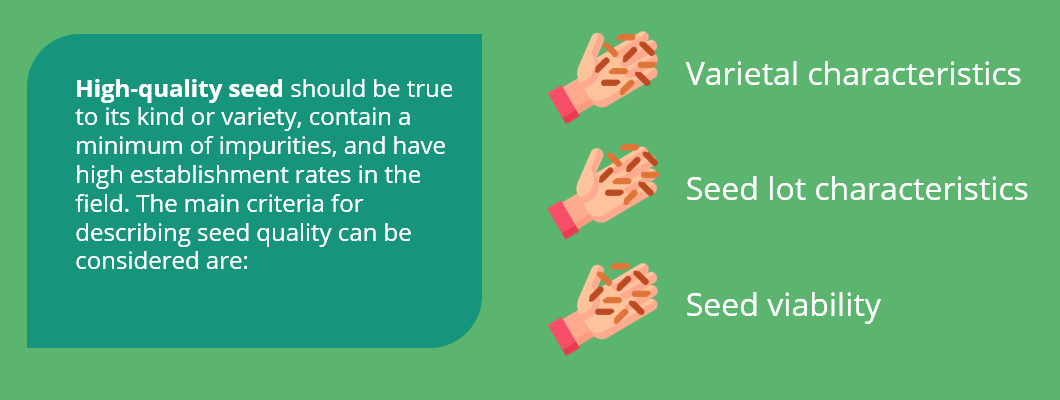
1. Varietal purity characteristics
2. Seedlot characteristics
A description of the seedlot includes the level of impurities, seed size, and damaged, deformed, or diseased seeds.
Impurities: The degree of contamination through weed seeds, seeds of other crops or species, and inert material, such as stones, dirt, or twigs are considered impurities. Impurity is expressed on a percentage basis by weight.
Seed size: Plumpness and/or fullness are generally desirable seed characteristics. These attributes indicate that the seed has the potential to produce vigorous seedlings under favorable conditions.
Damaged, deformed, or infected seed: Low-quality seed has seedborne diseases, insects, and other extraneous matter. High-quality seed should be free from various types of mechanical injury that reduce germination and seedling vigor.
Red rice: Red grains are not acceptable in the rice market place. Grains should not have more than 25% of their surface area colored red or red-streaked.
Seed viability: The viability of the seed in the field will be determined to a large degree from its stored moisture level, germination potential, and vigor.
Moisture content: This has a marked influence on the life and vigor of the seed. MC should be less than 14% for short-time storage and preferably less than 12% for extended storage times.
Germination percentage: This expresses the proportion of the total number of seeds that are alive. It is determined through controlled tests and actual counts of the number of seeds that germinate. Many varieties have a dormancy period immediately after harvest. Stored under traditional open systems, the germination rate of most rice seed begins to deteriorate rapidly
after 6 months.
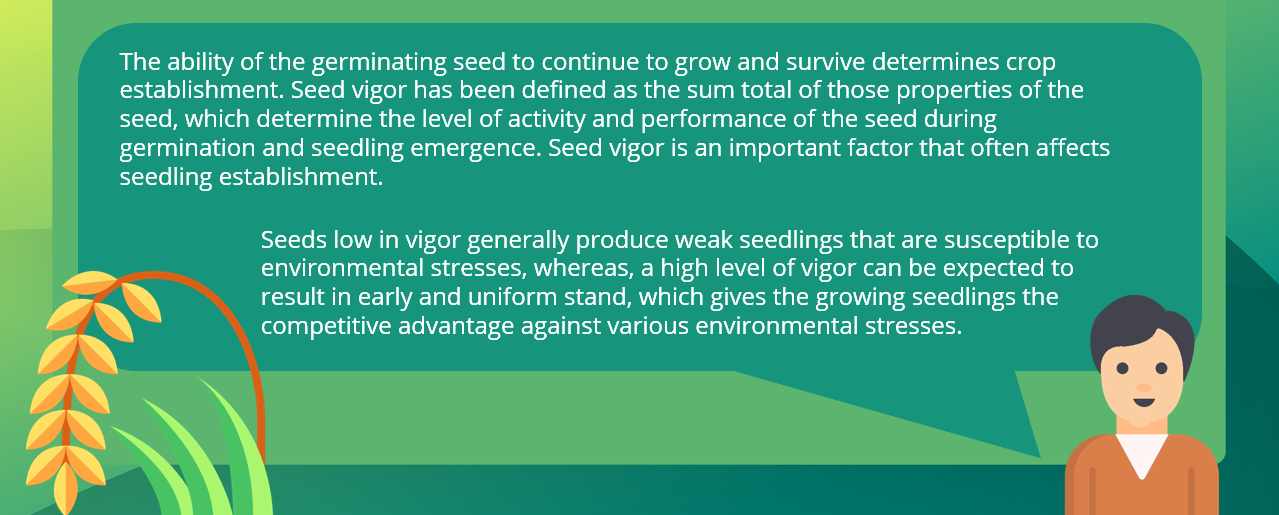
Seed vigor: This quality characteristic provides a very good estimate of the potential field performance, and subsequently, the field-planting value. While the speed of germination varies slightly across varieties, seeds should imbibe (absorb) moisture and within 2 days produce a root (radicle) and the first leaf (plumule) within 4 days. At this point, the seed is considered to have germinated.
Pure seeds:
The true seeds of the variety based on seed shape, size, and coloration; usually the majority of seeds. Other rice seeds appearing as off-types should be placed under rice varietal mixture.
Best seeds:
The pure seeds that are bold or fully filled, having no or low amount of discoloration (<0.5% discolored seed surface). Halffilled and empty will fall under partially filled or unfilled.
Spotted and discolored
There are two types of discoloration on rice seeds. One is spotting caused by certain diseases (brown spot) or insects (rice bug feeding damage). The other is discoloration on a portion or portions of the grains caused by Curvularia (black kernel) or sometimes by Alternaria padwickii (stackburn disease) or by sheath rot on certain occasions. Other rice diseases do not produce consistent discoloration. We consider any seed having more than 0.5% discolored or spotted seed surface as discolored. Discoloration can occur on fully or partially filled or empty grains.
Partially filled
Seeds that are not fully filled due to immaturity at harvest or due to infection of seeds by certain diseases or insect damage.
Deformed seeds
Seeds with abnormal shape due to mechanical pressure during grain formation or due to seed infection (sheath rot) or infestation with white tip or stem nematode.
Germinated seeds
Germination could be genetic in nature when there is no dormancy (vivipary) or when panicles come in contact with paddy water before harvest.
Smutted seeds (seed diseases)
These are generally those infected with false smut (Ustilaginoidea virens) or kernel smut (Tilletia barclayana) [organ-specific diseases].
Unfilled seeds
Glumes without endosperms could be due to several factors: failure of some spikelets to fertilize and form endosperm or ovary abortion due to early infection (e.g., brown spot, sheath rot, white tip nematode, black kernel, bakanae, etc.).
Other species
Seeds other than Oryza sativa.
Rice varietal mixtures
Mainly discriminated from true seed of the variety by difference in seed size, shape, seed coloration, awn, pubescence of lemma and palea, and seed coat color. Usually low in number.
Weed seeds
Seeds of other species, varying in size from large (Rottboella and Ischaemum spp.) to small (Scirpus juncoides), these are reported as number of seeds in the working sample.
Other plant parts
Usually are present in improperly processed seed lots having pieces of broken leaves, stem, or panicle branches.
Inert matter
Seeds that are not fully filled due to immaturity at harvest or due to infection of seeds by certain diseases or insect damage.
Insect damage
Seed lot infested by storage insects could be reported by counting the number of insect-damage seeds.
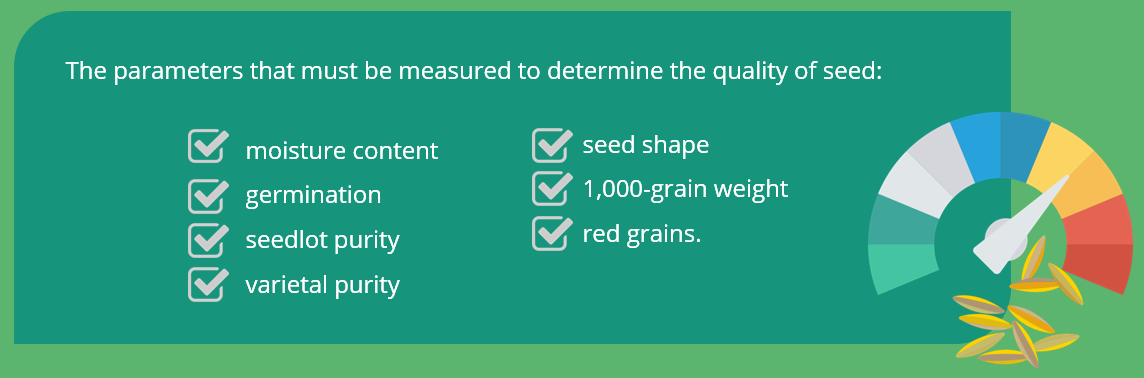
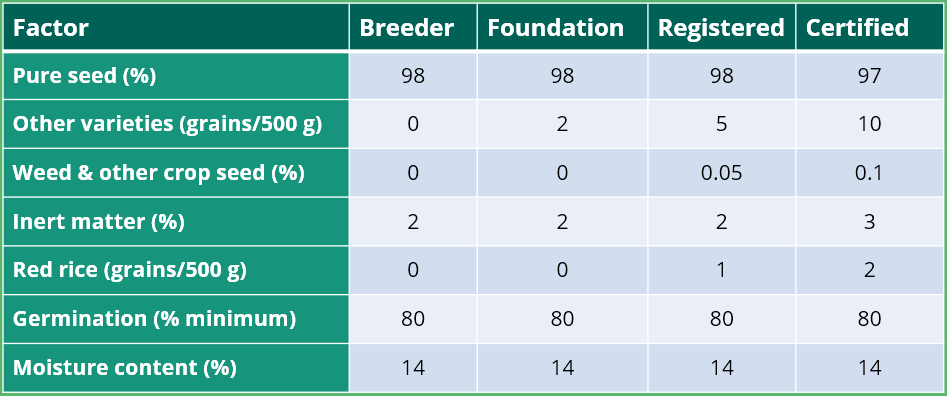
Many countries have their own standards that these parameters can be measured against.
1. Moisture content (MC)
There are two methods that can be used to measure MC. The primary or direct method, often called the oven-drying method, and the secondary method using electronic moisture testers.
Oven-drying method: This oven-drying method takes longer to perform, but provides the most reliable MC measurement. It is based on weight reduction. The sample is weighed and then placed in an oven until all water is removed and weighed again. MC is then calculated based on weight loss. Since weight measurements are highly accurate, this is the most accurate method.
- Set the oven at 130oC.
- Take the initial weights [mi] of three 100-gram seed samples.
- Place the three samples inside the oven and leave for 16–24 hours.
- Measure the final weight [mf] of each sample after the 16–24 hours.
- Compute the MC for each sample using the equation:

- Compute the average over three samples to obtain a reliable measure of the moisture content
Electronic moisture meter: This method uses a meter that measure the MC either by measuring the resistance or capacitance of a paddy sample.
- Read the operator’s instructions.
- Turn the moisture meter on.
- Ensure the machine is set for paddy.
- Fill the tray or bowl of the moisture tester with a sample of the paddy to be tested.
- Turn or press the knob until it is fully closed. The moisture is displayed.
- Test at least three samples and calculate the average of the three readings.
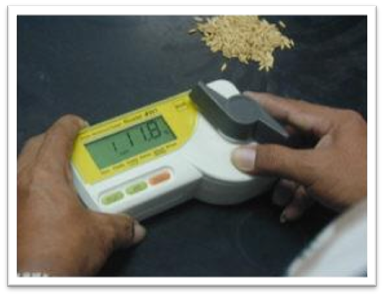
Moisture meters are most reliable after they have been calibrated. To do this, use the drying oven method to determine an accurate MC reading for a paddy sample. Test a sample from the same batch using the moisture meter and compare the results.
2. Germination test
A germination test is often the only test a farmer can conduct on the seed before planting. Monitoring the time taken to germinate will also give an indication of vigor.
Sampling: If the seed to be tested is from a seedlot contained in more than one bag, sample must be taken from several bags. A good rule of thumb for determining how many bags to sample is to take samples from a number of bags that represents the square root of the lot size. For example, if the lot contains nine bags, then sample at least three bags. If the lot contains 100 bags, then sample from at least 10 bags.

Procedure: Follow these steps.
- Place water-absorbent material inside the waterproof tray.
- Take random sample from each seed lot and mix in a container.
- Take at least three seed samples from the mixed grain.
- Count out 100 seeds from each sample and place on the water-absorbent material inside the tray.
- Carefully saturate the absorbent material.
- For each of 10 days: (1) check each day that the absorbent material remains most and (2) record the number of germinated seeds.
- Compute germination data for 5 days and for 10 days

The rate of germination is an indicator of vigor. Rapid seed germination increases the chance that seed will establish in the field.
Calculating the germination rate: Germination rate is the average number of seeds that germinate over the 5- and 10-day periods.

For example, if 86 seeds germinated in a tray of 100 seeds after 10 days, then 10-day germination (%) = 86 x 100/1 = 86%
3. Seedlot purity
The impurities measured to test the purity of the seed batch are:
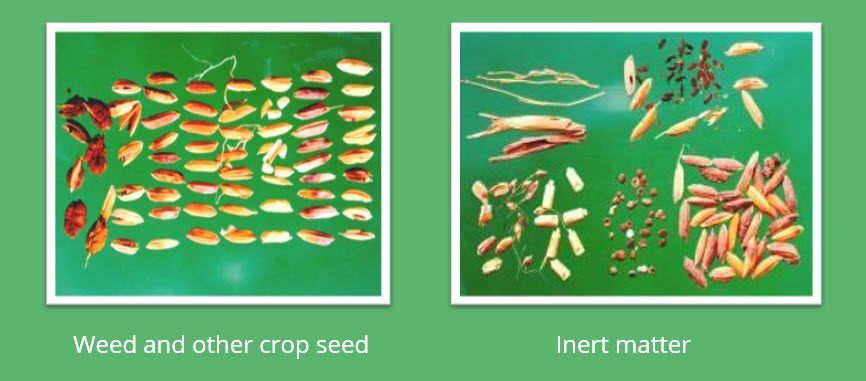 Procedure: Follow these steps.
- Select, at random, a sample of the seed. 100 g is a good sample size.
- Weigh the sample [A].
- Remove all of the weed and other crop seeds and the inert matter.
- Weigh the weed and other crop seed matter removed [B].

- Compute the weed percentage as follows:

- Weigh the inert matter removed from the sample [C], the inert matter percentage is calculated using the formula:

4. Varietal purity
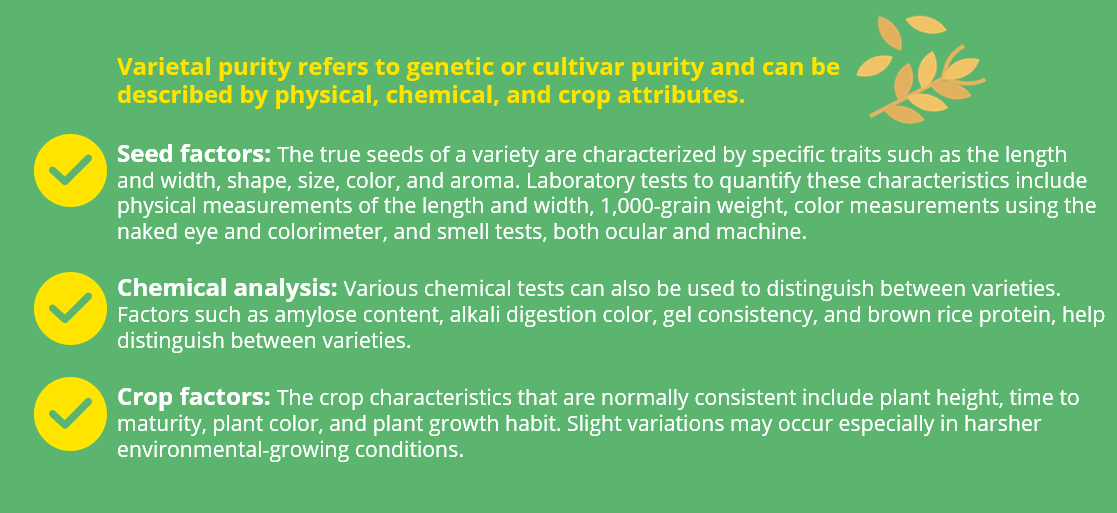
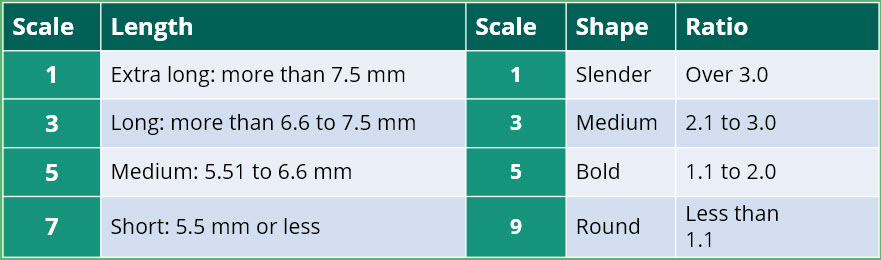
Grain dimensions: The grain size and shape (length to width ratio) is a very stable varietal property that can be used to measure the varietal purity of a sample. Comparing the length to width ratio of the sample with the published ratio for the variety indicates the varietal purity of the grain sample. Significant deviation indicates that the sample is impure, so it is either a different variety or a mixture of varieties.

Procedure: Following these steps:
- Obtain a random sample from the seed batch.
- Collect 20 grains at random from this sample.
- Use a Vernier caliper or photographic enlarger to measure the dimensions of each of the 20 grains.
- Tabulate the length and width of the grains and calculate the average.
Seed shape: To obtain the seed shape, the length to width ratio, use the following equation:

5. Weight-based sampling
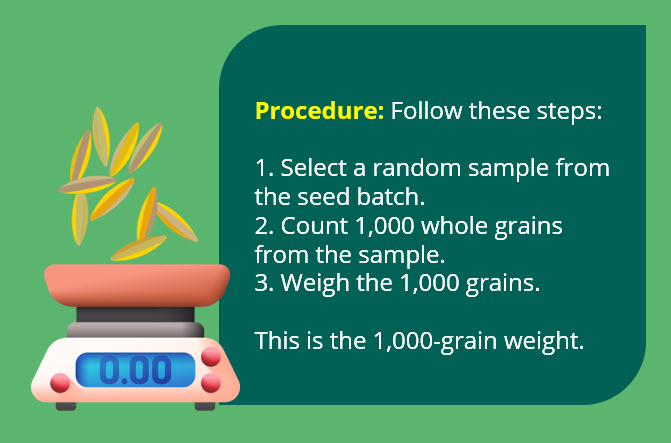
A second characteristic that measures varietal purity is the 1,000-grain weight. Each variety has a published weight for 1,000 grains. If the 1,000-grain weight calculated from the sample departs from this, it may be an indication that the sample contains a mixture of varieties.
6. Red grains
A grain is considered to be red if more than 25% of its surface area is red-colored or streaked.
Procedure: Follow these steps:
- Mill the sample.
- Select a random sample of the milled rice: 25 g is a good sample size.
- Weigh the sample [A].
- Select and separate the red grains from the sample. The red kernels are those that have 25% or more of the grain red.
- Weigh the red grains separated from the sample [B]. Calculate the percentage of red grains in the sample using the formula:

7. Recording the seed batch quality
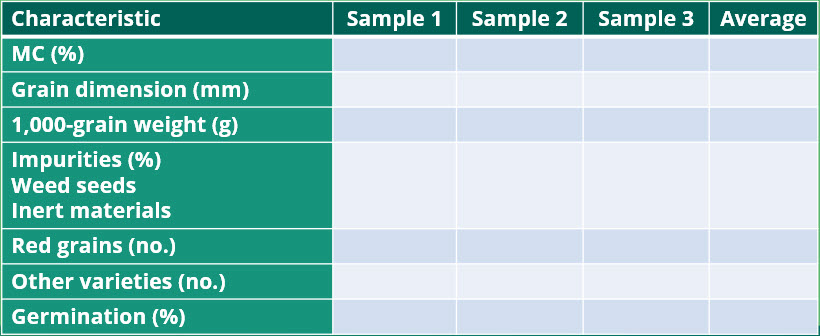
Take the sample of seed provided and conduct the range of quality tests described above. Use the test results to complete the sample spreadsheet in Table below.
Sample spreadsheet for reporting seed quality

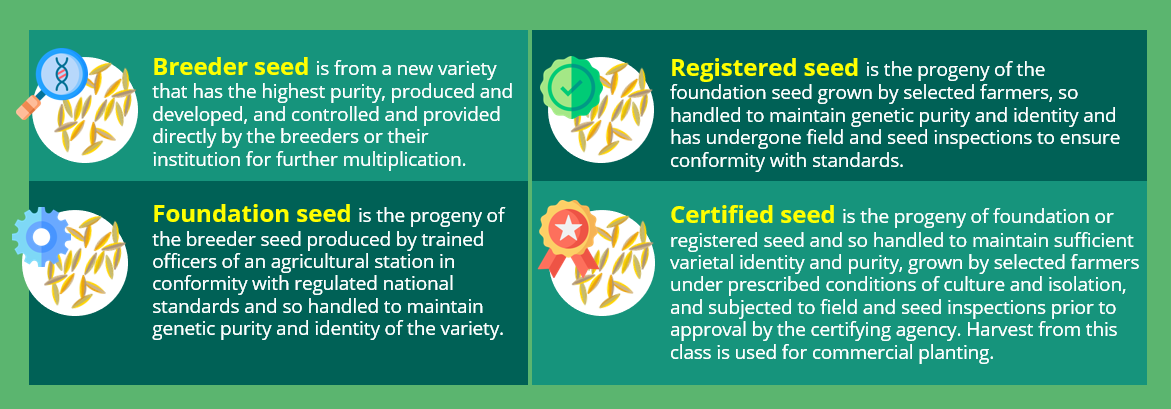
1. Classes of seed
2. Seed testing
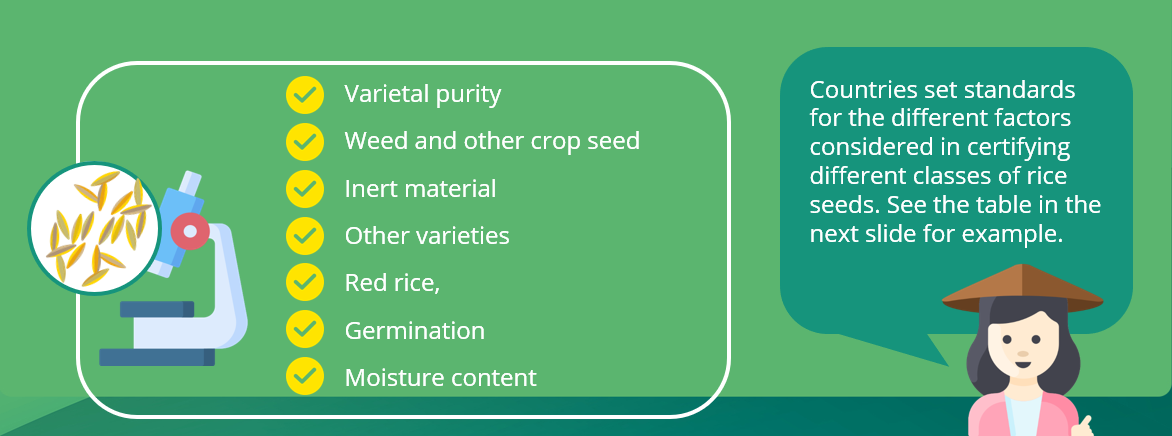
Seed samples are collected and submitted for laboratory analysis after drying and processing. Tests conducted include those that assess: